
The transition of data center interconnects to 400G and 800G transmission rates has intensified the need for precise fiber cabling design, particularly in the selection of MTP®/MPO harnesses. This paper examines the determinants of harness selection, arguing that the decision between Base‑8 and Base‑16 architectures is governed not by nominal link speed, but by the equipment interface specification and parallel optical fiber count. It proposes a four‑step selection methodology encompassing interface verification, fiber and connector specification alignment, routing and length planning, and future expansion compatibility. A practical checklist and analysis of common migration scenarios are provided to support network engineers in optimizing cabling infrastructure and minimizing costly re‑cabling.
The exponential growth in data center throughput demands has driven the widespread adoption of parallel optical transceivers. Unlike traditional serial links, parallel optics transmit data across multiple fibers simultaneously, requiring precise matching between the active equipment interface and the passive cabling infrastructure.
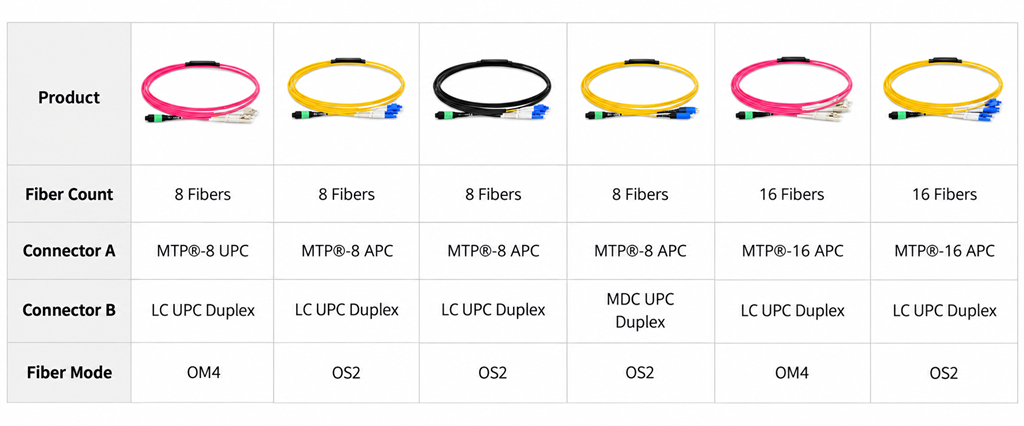
At the core of this infrastructure lies the MTP®/MPO harness—a multi‑fiber cable assembly that breaks out a trunk connector into individual duplex connectors (typically LC or MDC). The two dominant configurations in contemporary deployments are the 8‑fiber (Base‑8) and 16‑fiber (Base‑16) harnesses.
A persistent misconception in the field is that higher network speeds inherently require higher‑fiber‑count harnesses. This paper demonstrates that harness selection is fundamentally an architectural decision, not a speed‑based one, and provides a rigorous framework for making that decision correctly.
